Key Takeaways
- Is ad fatigue real? Yes. The phenomenon survives scrutiny — but roughly half the numbers used to prove it do not.
- We traced the six most-repeated ad fatigue statistics to their origin. Two check out against a primary source. Two are folklore or distortion. Two can’t be verified as attributed.
- The famous “4,000–10,000 ads a day” figure has no study behind it. It traces to a 2017 Forbes contributor post and a 2015 agency blog that counted ads over breakfast.
- The “Rule of 7” is 1930s movie-studio lore. The real research it’s confused with — Krugman, 1972 — argues for three exposures and calls the “must-repeat” belief a myth.
- The strongest number in the category comes from Simulmedia’s own first-party data: a 5.7% purchase-intent lift on first exposure, decaying after five to six views.
Every article on ad fatigue cites the same handful of ad fatigue statistics. Read ten of them and you’ll see the same percentages migrate from page to page — a 35% drop here, a 4,000-to-10,000 there, a “Rule of 7” everywhere. What almost none of them do is link the primary source. Several, when you follow the trail, simply cite each other in a circle until the number has no origin at all.
So we ran the audit nobody in this niche seems to have run. We took the six claims that show up most often, chased each one back to where it starts, and wrote down what we found — including the ones that survived.
That last part matters. This isn’t a debunking. Some of these numbers are solid, sourced, and worth quoting. The point is knowing which ones — because a statistic you can’t trace is a liability the moment a smart prospect asks, “says who?”
Is ad fatigue real, or just a number marketers repeat?
Ad fatigue is real. Independent research from different methods — controlled exposure tests, first-party campaign data, and consumer surveys — all point the same direction: repeated exposure to the same creative erodes response and, past a point, actively annoys people. The disagreement isn’t whether fatigue exists. It’s about the specific figures the industry uses to describe it, many of which were never measured the way they’re quoted.
Here’s how each of the six most-cited claims held up.
The method: how we traced each claim
The rule was simple. Start with the statistic exactly as it appears in blog posts. Follow every “according to” backward. Keep going until the trail lands on one of two things: a primary source (a published study, a dataset, a first-party experiment with stated methodology) — or a dead end (another blog citing another blog).
A claim only “checks out” if it terminates in a primary source that says what the blogs claim it says. Close-but-different counts as a miss. Attribution to the wrong party counts as a partial.
The audit at a glance
| # | The claim (as it circulates) | Attributed to | Where it actually traces | Verdict |
|---|---|---|---|---|
| 1 | The average person sees 4,000–10,000 ads a day | “Forbes,” “a study,” “clinical tests” | A 2017 Forbes Agency Council contributor post citing unnamed “experts,” popularized by a 2015 agency blog. No study produced the range. | ❌ Unsupported |
| 2 | It takes 7 exposures before someone buys (“Rule of 7”) | “Psychology,” “a 1940s study,” the movie industry | 1930s Hollywood marketing lore. The real effective-frequency research (Krugman, 1972) argues for three and calls the repetition myth a myth. | ⚠️ Folklore; real source says 3 |
| 3 | Ad fatigue cuts CTR ~35% and raises CPC ~20% | AdEspresso | Stat roundups citing each other. AdEspresso’s actual documented test reported a different metric and number (~10% CPC change from flipping creative). | ❌ Circular / distorted |
| 4 | 41% of consumers tune out ads on social media | Nielsen | Secondary roundups (“cited in…”). Nielsen’s closest real research measures ad trust, not tune-out, and yields no matching figure. | ⚠️ Unverifiable as attributed |
| 5 | First exposure lifts purchase intent 5.7%; response decays after 5–6 views | Simulmedia | Simulmedia’s own published research. First-party, methodology stated. | ✅ Checks out |
| 6 | 61% are less likely to buy from brands that over-repeat ads; ~49% have stopped buying | “Harris Poll” | A real survey — fielded by The Harris Poll, released by Ad-ID. Holds up; the usual credit just omits who commissioned it. | ✅ Checks out (mis-credited) |
Claim 1: “The average person sees 4,000 to 10,000 ads a day”
This is the most-quoted number in the entire category, and it’s built on sand.
Follow it back and it lands, almost every time, on a single 2017 Forbes Agency Council post — a contributor article, not Forbes newsroom reporting — which states the range and attributes it to “digital marketing experts” with no citation. The figure had been circulating since a 2015 blog by an agency owner who admitted he thought the number sounded ridiculous, started counting his own ad exposures one morning, and reached several hundred before he’d finished breakfast. That’s an anecdote, not a measurement.

There is real research on ad exposure. The most-cited academic attempt — Bauer and Greyser’s 1968 study — put the number of ads consumers noticed at roughly 76 a day, out of a far larger pool they were technically exposed to. Every serious estimate since has stressed how hard the figure is to pin down.
Verdict: Unsupported. The range is a guess that got laundered into a citation by repetition. Quote it and you’re quoting a breakfast anecdote.
Claim 2: “It takes 7 touches before someone buys” — the Rule of 7
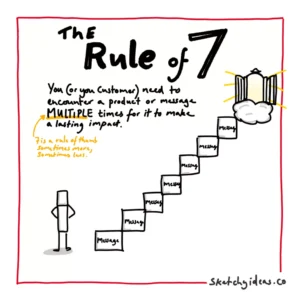
The Rule of 7 is treated as settled science. Its origin is a movie poster.
The concept is most often traced to 1930s Hollywood studios, which believed audiences needed to see a film’s promotion several times before buying a ticket. There is no primary study behind the number seven. When posts try to source it, they wave at “a 1940s study” or “consumer psychology” without naming either.
The genuine research on how many exposures an ad needs is real — and it says something different. In 1972, psychologist Herbert E. Krugman published Why Three Exposures May Be Enough in the Journal of Advertising Research. His model was three: the first exposure asks “what is it?”, the second “what of it?”, and the third is the decision. Everything beyond that, he argued, is reminder. He went further and called the belief that audiences forget you unless you repeat constantly a myth — one that conveniently justified bigger media budgets.
So the folklore says seven; the actual literature says three and warns against over-frequency. Those are not the same claim.
Verdict: Folklore. Cite Krugman, not the Rule of 7.
Claim 3: “Ad fatigue cuts CTR by 35% and raises CPC by 20%” — per AdEspresso
This one is instructive because it looks sourced. It names a specific, credible originator — AdEspresso — and gives two precise figures. That specificity is exactly what makes it spread.
Trace it, though, and the “AdEspresso” attribution in most posts routes through other statistics roundups that cite each other, not through anything AdEspresso published. When you find AdEspresso’s actual documented work on creative fatigue, the numbers don’t match: their well-known experiment involved mirror-flipping a tired creative and reported roughly a 10% change in cost-per-click — a different metric, a different magnitude, and a different point (that a small creative change can revive a fatigued ad).
Somewhere along the chain, a real but modest finding mutated into a tidy “35% CTR / 20% CPC” pairing that we could not locate in any AdEspresso primary source.
Verdict: Circular / distorted. A real name attached to numbers that real source doesn’t appear to have published.
Claim 4: “41% of consumers tune out ads on social media” — per Nielsen
Nielsen is a strong name to have on a stat, which is why this one travels well. The problem is the attribution is a pointer to a pointer.
Where posts source it, they say “a Nielsen study cited in [some roundup]” — the citation is the roundup, not Nielsen. And when you go to Nielsen’s actual advertising research, the flagship work in this area (the Global Trust in Advertising reports) measures how much consumers trust different ad formats, not how many tune them out. There’s no clean Nielsen figure that reads “41% tune out ads on social.” The closest matching numbers in Nielsen’s data are about trust, and some run in the opposite direction (a similar percentage trusting a given format).
The claim may be a genericized descendant of a real survey, but as attributed and quoted, we couldn’t verify it.
Verdict: Unverifiable as attributed. Treat with caution until the primary surfaces.
Claim 5: “First exposure lifts purchase intent 5.7%; it decays after 5–6 views” — Simulmedia
Here’s one that holds — cleanly.
The frequency-decay figures that appear across the category (a 5.7% purchase-intent lift on first exposure, then declines as exposure climbs into the 6–10 and 11-plus ranges) trace directly to Simulmedia’s own published research. It’s first-party data from a company that measures TV and CTV campaigns, published on their own domain, with the direction and magnitude stated plainly: one exposure helps, and past roughly five to six exposures, additional frequency starts working against you.
Because it’s first-party, you can attribute it precisely and stand behind it. That’s the difference between a citation and a rumor.
Verdict: Checks out. Quote it, and credit Simulmedia directly.
Claim 6: “61% are less likely to buy from brands that over-repeat ads” — the “Harris Poll” number
This is a real survey that’s usually credited to the wrong party.
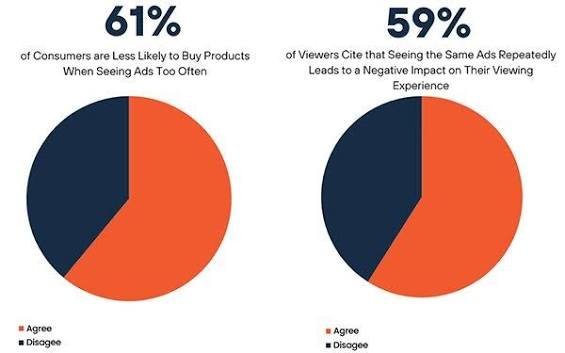
The finding — roughly six in ten U.S. adults are less likely to buy from companies that show the same ads repeatedly, and about half have decided not to buy from a brand that shows ads too often — was fielded by The Harris Poll but released by Ad-ID, as eMarketer’s coverage makes clear. Most blog citations name only “Harris Poll,” which is the polling firm, not the organization that commissioned and published the data.
The number itself is sound. The attribution is just incomplete — and incomplete attribution is how solid stats slowly drift into unsourced ones over successive re-quotings.
Verdict: Checks out, mis-credited. Cite it as Ad-ID / The Harris Poll.
What the audit proves
Put the six side by side and a pattern appears. The claims that describe consumer sentiment and measured behavior — Simulmedia’s decay curve, the Ad-ID survey, Krugman’s three-exposure model, and controlled CTV exposure studies like MAGNA’s work with real brands — converge on the same conclusion from independent directions: repetition erodes response, and over-frequency damages both performance and brand perception.
The claims that fall apart are the round, dramatic, context-free numbers — the ones engineered to be repeated rather than examined. “4,000 to 10,000 ads a day.” “35% and 20%.” “The Rule of 7.” They spread precisely because they’re tidy, not because they’re true.
So the honest headline isn’t “ad fatigue is a myth.” It’s the opposite: ad fatigue is real enough to survive an audit that half its own citations don’t. The phenomenon is better sourced than the folklore around it.
The standard behind this audit
We ran this exercise because it’s the standard we hold our own reporting to. Before a number reaches a client strategy or a review slide, it gets traced the same way — back to a primary source, or it doesn’t get used.
That’s why this sits on our blog instead of another recycled “15 shocking stats” list. Anyone can repeat a figure. Telling a client exactly where it came from — and which competitors’ decks are built on breakfast anecdotes — is the part that changes decisions.
If you’d rather your marketing ran on numbers that survive that kind of scrutiny — measured in revenue, not repeated statistics — that’s the conversation to have with us.
FAQ
Is ad fatigue real?
Yes. Multiple independent research methods — first-party campaign data, controlled exposure tests, and consumer surveys — all show that repeated exposure to the same creative reduces response and, past a threshold, increases annoyance and hurts brand perception. What’s unreliable is a portion of the specific figures the industry quotes, not the underlying effect.
How many ads do people see in a day?
Nobody has a defensible exact number. The popular “4,000 to 10,000 a day” range has no study behind it. The most-cited academic estimate (Bauer and Greyser, 1968) put consciously noticed ads at around 76 a day. The true figure is hard to measure and varies enormously by person and media diet.
How many times should someone see an ad before it works?
The most credible research — Herbert Krugman’s 1972 work — supports roughly three effective exposures, not the popular “seven.” Beyond a handful of exposures, additional frequency tends to deliver diminishing and then negative returns, which is the mechanism behind ad fatigue.
Which ad fatigue statistics can I trust?
The ones that trace to a first-party or primary source: Simulmedia’s published frequency-decay data and the Ad-ID / Harris Poll consumer survey both check out. Be cautious with the “4,000–10,000 ads/day” figure, the “Rule of 7,” and the “35% CTR / 20% CPC” AdEspresso claim, none of which we could verify against a primary source as commonly quoted.
Keep learning with people doing the work.
Join the Stay Ahead community for useful marketing updates, practical resources, workshops, and real conversations.